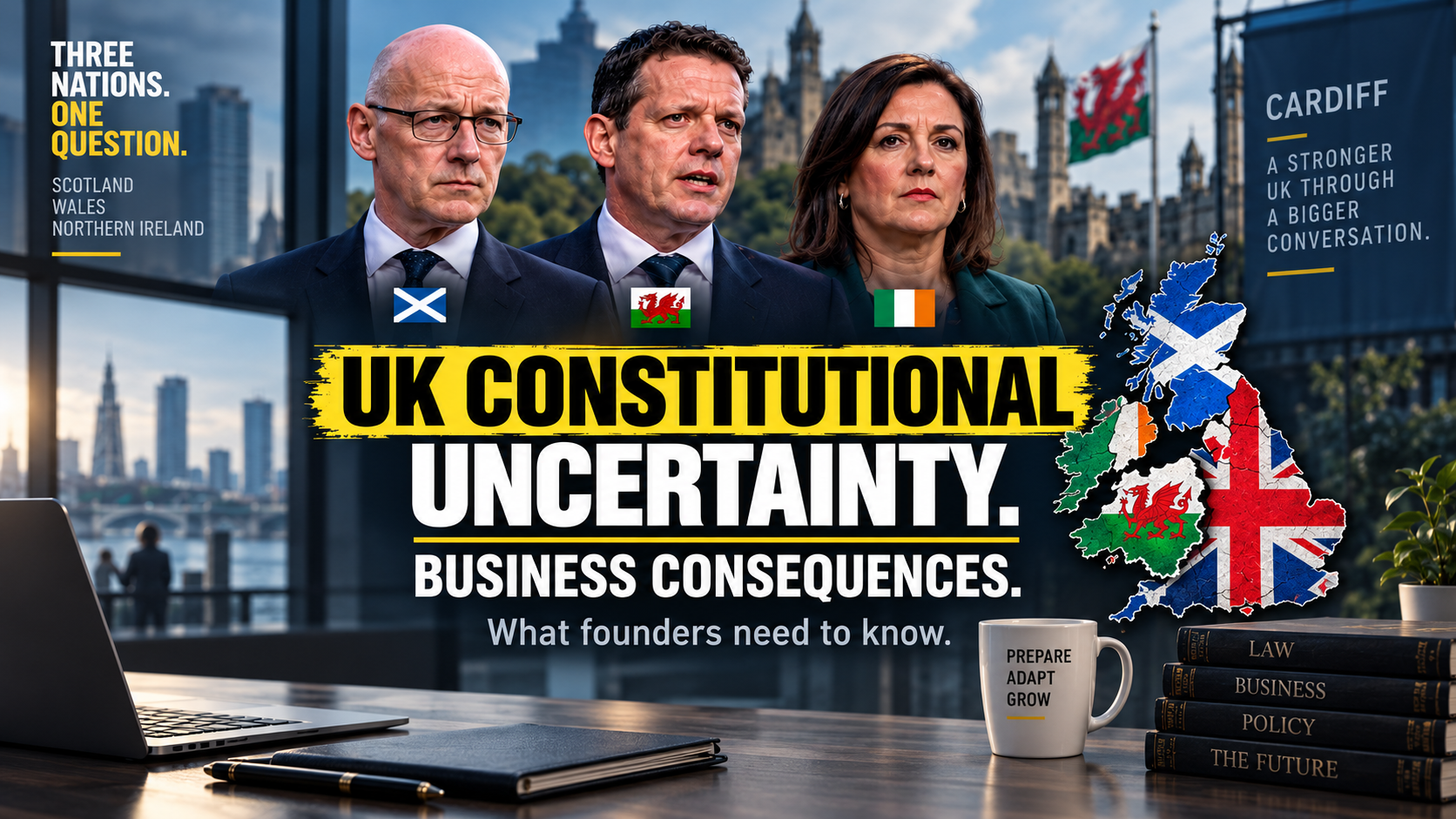
The UK Does Not Have to Break Up to Disrupt Your Business
What the Cardiff agreements do—and do not—mean for founders, contracts, cash flow and business continuity.
By Dogetlawyer | Constitutional and business analysis | 15 September 2026
A political declaration does not rewrite your contracts. But it can make people start reading them more carefully.
Imagine an investor asking a founder: “Your customers, staff and suppliers operate across the UK. What happens to this business if the rules change?”
Would the answer be a business plan—or a political opinion?
That is the commercial question behind the constitutional debate following Cardiff. Not whether every founder should panic. Not whether independence, reunification or the existing Union automatically offers the best future.
Which assumptions in your business would become expensive if the rules changed?
The answer starts with separating political ambitions, legal powers and practical business decisions.
Phase 1: Understand the constitutional problem before predicting the outcome
Two Cardiff agreements—not one decision to dissolve the UK
On 14 September 2026, leaders of the SNP, Plaid Cymru and Sinn Féin agreed a political memorandum in Cardiff. It sets out cooperation between their parties and their ambitions for constitutional change. It is not a treaty in which three governments agree to dissolve the United Kingdom. [1]
Separately, the Welsh and Scottish Governments signed the Cardiff Agreement, or Cytundeb Caerdydd. This provides a framework for cooperation on shared policy priorities. Its text expressly states that it is not legally binding and does not affect either government’s statutory powers or responsibilities. [2]
One document coordinates party-political ambitions. The other establishes a framework for government cooperation. Neither document, by itself, changes a border or authorises a referendum. [1][2]
For a business, that distinction is fundamental. There is no basis in these documents alone for announcing new tax treatment, moving employees or treating domestic contracts as international agreements.
Political significance is not the same as immediate legal effect.
Why the dissatisfaction should be taken seriously—but not generalised
The party memorandum connects constitutional change with dissatisfaction over economic policy, control of energy resources and the consequences of Brexit. Its signatories also argue that decisions about their constitutional futures should rest with their own populations. These are their political positions—not proof that every voter shares them or that their preferred solutions would succeed. [1]
Stephen Clear’s earlier writing helps explain the underlying tension. In his 2018 article, republished by Bangor University, he examined how Westminster could retain the legal power to proceed with Brexit legislation despite devolved objections, while facing political consequences over consent. [3]
The distinction remains useful: an argument can be legally resolved without being politically settled.
But the reverse matters too. An asserted democratic mandate does not automatically create a legal power, and winning an election does not establish how voters would answer a separate constitutional question.
Is this a constitutional crisis?
Dogetlawyer’s assessment is that the agreements demonstrate constitutional strain. They do not, on their own, establish that the constitutional system has stopped functioning.
The harder issue is whether competing claims about consent and authority can be addressed through credible processes.
What conditions should justify reconsidering a constitutional settlement? Who should assess the evidence? What should voters know before making a decision?
Clear’s January 2024 discussion of Wales’s future shows why the debate is wider than a choice between separation and doing nothing. He examined the Welsh constitutional commission’s different options and its call for informed public discussion. [4]
The commission’s own final report assessed enhanced devolution, a federal structure and independence. It identified strengths, weaknesses, risks and opportunities in each, without selecting one as the best outcome. [5]
A serious discussion must therefore examine both the case for change and the case for retaining the present arrangements.
Three movements, different legal routes
Scotland: In 2022, the Supreme Court held that the proposed Scottish independence referendum legislation concerned reserved matters and therefore fell outside Holyrood’s existing legislative competence. The ruling did not decide whether independence was desirable. The 2014 referendum had been enabled by a temporary modification of the reserved-matters framework. [6]
Northern Ireland: The Northern Ireland Act 1998 provides a distinct process. The Secretary of State may call a border poll and must do so when it appears likely that a majority of those voting would support leaving the UK and forming part of a united Ireland. A majority vote would require an implementation process; it would not instantly complete reunification. [7][8]
Wales: There is no equivalent statutory border-poll trigger. The union of Wales and England is reserved under the current settlement, and obtaining powers for an independence referendum would require legal change. [8]
For founders, the implication is simple: analyse the actual jurisdiction and proposal. A common political platform does not create a common legal timetable.
Phase 2: Follow the uncertainty into an actual business
Begin with the evidence—not an assumption of economic collapse
The Office for the Internal Market’s March 2026 report assessed the UK internal market as broadly stable and functioning effectively overall, while identifying areas requiring government cooperation over potential regulatory differences. This was a pre-Cardiff assessment, not a study of the summit’s consequences. [9]
There is also historical evidence that uncertainty can influence business decisions before a transition is complete. A 2019 Bank of England working paper estimated that anticipation of Brexit reduced investment by approximately 11% over the three years following the 2016 referendum. The researchers also identified management time spent on Brexit planning as a productivity cost. [10]
That is research about Brexit—not a prediction of the economic effects of the Cardiff agreements.
The practical lesson is to examine specific ways uncertainty could affect the business, rather than borrowing a historical percentage and presenting it as tomorrow’s forecast.
Public finances: difficult numbers require more than slogans
In its August 2026 assessment of Scotland’s public-finance figures, the Institute for Fiscal Studies explained that the estimates reflect the existing constitutional settlement. They are not the Scottish Government’s own borrowing position or a forecast of an independent Scotland. Nevertheless, the IFS considers them a relevant starting point for examining the fiscal challenges independence could involve. [11]
Research by Guto Ifan, Cian Siôn and Daniel Wincott presents a similarly uncomfortable argument for both sides in Wales. It links Wales’s fiscal position to longstanding economic underperformance within the UK, while also identifying difficult fiscal and economic choices that independence would entail. [12]
The Scottish Government has published its positive case and proposals for independence. Those should be examined as proposals, rather than dismissed as nonexistent or accepted as independent proof that the promised benefits would follow. [13]
For business planning, ask which assumptions concern taxation, spending, trade and growth; which require agreement with other governments; and what would happen if implementation took longer or cost more than expected.
Neither guaranteed prosperity nor inevitable decline is a sound forecasting assumption.
Cash flow: the first problem might be a payment delay
Consider this hypothetical business, not a company reporting losses caused by Cardiff.
It invoices £40,000 a month, with steady sales, all on credit. Using a 30-day month, an additional 15-day collection delay would leave approximately £20,000 more tied up in unpaid invoices:
£40,000 × 15 ÷ 30 = £20,000.
Revenue has not necessarily disappeared. Cash is arriving later, while wages and other commitments may still fall due on time.
This is an illustrative working-capital calculation, not a forecast of customer behaviour or a complete cash-flow model.
Practical response: test whether the business could absorb slower collections or a deferred project. Examine overdue invoices, customer concentration and unavoidable payments. Make a proportionate decision based on the results—not a blanket decision to stop investing because of a headline.
Contracts: an old ambiguity may matter more than a future border
Imagine a five-year distribution agreement granting exclusivity across “the United Kingdom”.
Does the contract define its territory? Are payment currency and tax responsibilities clear? Who bears the cost of a relevant legal change? What does the agreement say about notices, renewal and disputes?
These questions do not imply that the document has suddenly become defective. They identify assumptions worth testing in a commercially important agreement.
One distinction already exists: the UK has three separate legal systems—England and Wales, Scotland, and Northern Ireland. A generic reference to “UK law” therefore deserves review rather than being treated as a complete governing-law answer. [14]
Nor should a founder assume that force majeure permits cancellation, repricing or alternative performance. In the English-law case RTI Ltd v MUR Shipping BV, the Supreme Court held that, without express wording, the relevant reasonable-endeavours requirement did not oblige a party to accept performance outside the contract’s terms. [15]
Practical response: obtain targeted advice on material agreements. Review the allocation of risk and the actual contractual wording before adding a generic “political uncertainty” clause.
A broad escape clause may protect you in one situation and give an important customer an unwelcome exit in another.
Procurement: “we sell across the UK” is not a compliance assessment
Imagine a Welsh software company bidding to supply both a Welsh council and a Scottish health board. It assumes the same tender-compliance pack will work for each.
That assumption already needs checking.
Scottish Government guidance issued in February 2026 explains the distinct rules applicable to devolved Scottish contracting authorities. For collaborative procurement, the lead authority and the framework used can determine the rules governing the award or call-off. [16]
This is an existing operational issue—not a new barrier created by the Cardiff meeting.
Practical response: check the authority, procedure, framework conditions and deadlines for each opportunity. Do not reuse the legal assumptions from an earlier bid merely because the next customer is also in the UK.
The relevant question is: “Which rules govern this transaction?”
Data: the location of your servers is only part of the answer
Consider a software business with UK-hosted systems and an overseas external support provider.
The ICO explains that a restricted international transfer can arise when personal information is made accessible to a separate organisation outside the UK, where the relevant conditions apply. Remote access can therefore matter even when the database itself remains in the UK. [17]
That is a current compliance question. It does not mean that sharing data between UK locations becomes an international transfer because political parties issue a declaration.
Practical response: map the entities processing personal data, their locations, access rights and safeguards. Assess any future constitutional change against the law and transitional arrangements actually adopted.
Do not move infrastructure because of a political prediction. Understand your existing arrangements before deciding whether anything needs to move.
People and suppliers: your registered office is not your entire business
A hypothetical company registered in England could depend on a Scottish manufacturer, Welsh public contracts, a Belfast distributor and staff working in several locations.
Its registered address does not reveal which relationship would be hardest to replace.
Practical response: identify the relevant contracting or employing entities, where work takes place, and which permissions, grant conditions or regulated activities need scrutiny. Seek jurisdiction-specific advice when a concrete proposal could materially affect them.
Do not tell staff that they need new permissions, or assume that a licence has expired, without identifying an actual legal requirement.
A possible future change belongs in a scenario assessment—not in an employee announcement presented as settled law.
The overlooked exposure: founder time
The Bank of England research also offers a warning about the cost of preparation itself: management attention devoted to uncertainty is time not available for other work. [10]
For a small team, that raises a practical question. Who checks developments, and what would justify escalating them?
Practical response: assign an owner, define the sources and agree a review schedule. A relevant bill should not disappear into a group chat, but every political speech need not trigger a new company-wide planning exercise.
Phase 3: A proportionate 30-day preparation plan
The following is a suggested management exercise, not a legal deadline or a prediction that constitutional change will occur within 30 days.
Week 1: Map the dependencies you cannot afford to misunderstand
Create a one-page record of key customers, suppliers, contracts, staffing locations, data arrangements and regulated activities.
Prioritise consequences, not merely contract value. A relatively small supplier controlling an essential system may deserve more attention than a larger relationship that could be replaced readily.
For each material dependency, record the relevant entity and jurisdiction, the current source of any requirement, the responsible person and the next review point.
Ask: “Where would a change in rules actually reach us?”
Week 2: Review important contracts before inventing new clauses
Start with current weaknesses: unclear territory, inconsistent governing-law wording, uncertain notice procedures or poorly understood termination rights.
For a tailored change-in-law mechanism, discuss a defined trigger, evidence of material impact, notice requirements, mitigation, a negotiation process and an agreed fallback with the solicitor advising on the contract.
Make the commercial trade-off explicit. Is the objective continuity of service, a controlled price adjustment, an orderly exit—or something else?
A provision cannot sensibly allocate a risk that the parties have not identified.
Week 3: Stress-test cash and commitments
Model a normal case, a temporary delay case and a case involving identifiable extra costs.
What happens if a large project starts later? What happens if a major customer pays more slowly? Which commitments cannot be deferred without further agreement?
Use assumptions you can explain. Do not invent a probability for constitutional outcomes simply because a spreadsheet has a space for one.
Then favour proportionate, reversible preparations over expensive moves based on speculation. Improving records and understanding payment exposure are different decisions from relocating an entire company.
Week 4: Agree what evidence would trigger action
Use three decision stages.
Political statement or party agreement: record it, assess relevance and monitor. Do not treat it as a new legal obligation.
Formal proposal, bill or authorised constitutional process: examine the exposure, test scenarios and obtain targeted advice where material. Preparation may be sensible before enactment, but a proposal must still be labelled as a proposal.
Enacted rule or authoritative implementation requirement: confirm its legal status, scope, commencement and transitional arrangements, then assign responsibility for any necessary response.
Track ordinary regulatory changes too. A referendum is not the only event capable of affecting the operating environment.
Preparation should preserve choices—not create unnecessary commitments.
Phase 4: Demand a transition plan, not another slogan
Both sides must explain how their preferred future would work
Those advocating constitutional change should be pressed on their proposed arrangements for trade, currency where relevant, public finances, regulation, existing rights and implementation.
Those defending the Union should explain how the present settlement can deliver effective cooperation, clear accountability and a credible response to disagreements.
Commercial uncertainty should not become a permanent veto over democratic debate. Equally, democratic aspirations should not become an excuse to avoid transition questions.
From a business perspective, the useful questions are concrete: what continues, what changes, who administers it, and how much preparation time would be available?
A date is not a transition plan. “Trust us” is not an implementation strategy.
Watch for opportunities as carefully as risks
The Welsh–Scottish government agreement includes cooperation on economic growth, living standards, climate resilience and international engagement. Its significance is therefore not confined to arguments about independence.
Our business interpretation is that founders should watch for practical programmes and consultations as well as political confrontation.
But an agreement is not a grant award. A policy ambition is not a purchase order.
Investigate actual procurement notices, funding criteria and programme conditions before treating an opportunity as commercially available.
What useful legal technology should do
For Dogetlawyer, the useful contribution is to connect a verified legal development with a practical business question—not to sell certainty about a constitutional outcome.
The standard we should demand from legal technology is straightforward:
Verified source → relevant business exposure → proportionate action → accountable review.
A founder should be able to see why a development matters to a particular contract, payment process or compliance activity. They should also know when the available information is insufficient and where professional judgement is necessary.
Technology should not silently turn a political forecast into a compliance obligation or a recommendation to rewrite a material agreement.
The bottom line: a political opinion is not a business continuity plan
You do not need to support independence to prepare for it as a possibility. You do not need to oppose it to scrutinise the proposed costs.
And you do not need to predict the UK’s constitutional future to fix an unclear contract, understand customer concentration or improve operational records.
Start with your most important agreement, your hardest-to-replace dependency and one realistic payment-delay scenario.
That is a more useful first step than trying to predict the next flag.
The UK does not have to break up for your business assumptions to deserve a closer look.
Before your next business review, ask: where would uncertainty reach us first—customers, contracts, staffing or cash flow?
This is general legal information, not legal advice. The applicable rules depend on the jurisdiction, facts and any subsequent legislation. Obtain appropriate professional advice before making material legal, tax or restructuring decisions.
This is Dogetlawyer commentary. Political positions, research findings and legal authorities are attributed to their sources. Business examples and the 30-day plan are illustrative. Citation does not imply endorsement by Stephen Clear, Bangor University or any other cited author or institution.
References
Numbered endnotes for a commercial website. Legal authorities use OSCOLA-informed citation conventions. The same reference number identifies the same source wherever it is cited. Online sources consulted on 15 September 2026; historical publication dates are stated separately.
[1] Kirsteen Paterson, ‘In full: The SNP, Plaid Cymru and Sinn Féin memorandum of understanding’ (Holyrood, 14 September 2026). Includes the full text of the parties’ political memorandum.
[2] Welsh Government and Scottish Government, Cardiff Agreement (Cytundeb Caerdydd): agreement between Welsh and Scottish Government (14 September 2026), especially ‘Shared vision’, ‘Shared areas of cooperation’ and ‘Ways of working’.
[3] Stephen Clear, ‘Scotland’s Brexit Bill rejection could be the start of a new constitutional crisis’ (Bangor University, 16 May 2018), republished from The Conversation.
[4] Stephen Clear, ‘What does Wales’ future hold? New report maps options for more devolution, federal and independent futures’ (Public Law Reflections, 23 January 2024), republished from The Conversation.
[5] Independent Commission on the Constitutional Future of Wales, Final Report: Executive Summary (Welsh Government, 17 January 2024), especially ‘Protecting devolution’ and ‘Options for the future governance of Wales’.
[6] Reference by the Lord Advocate of devolution issues under paragraph 34 of Schedule 6 to the Scotland Act 1998 [2022] UKSC 31, paragraphs 5–8, 77–83 and 92 (judgment, 23 November 2022).
[7] Northern Ireland Act 1998, section 1(1)–(2) and Schedule 1, paragraphs 1–2. The relevant statutory provisions are also quoted and explained in reference [8].
[8] David Torrance, The United Kingdom and independence (House of Commons Library Research Briefing CBP-10649, 8 May 2026), ‘Leaving the Union(s)’.
[9] Office for the Internal Market, 4th annual report: developments in the UK internal market 2025 to 2026 (Competition and Markets Authority, 25 March 2026), ‘Executive summary: Key findings’.
[10] Nicholas Bloom, Philip Bunn, Scarlet Chen, Paul Mizen, Pawel Smietanka and Gregory Thwaites, The impact of Brexit on UK firms (Bank of England Staff Working Paper No 818, 30 August 2019), abstract.
[11] David Phillips and João Sousa, ‘2025–26 Government Expenditure and Revenue Scotland (GERS) estimates: IFS response’ (Institute for Fiscal Studies, 12 August 2026). DOI: 10.1920/co.ifs.2026.0063.
[12] Guto Ifan, Cian Siôn and Daniel Wincott, ‘Devolution, Independence and Wales’ Fiscal Deficit’ (2022) 261 National Institute Economic Review 16–33. DOI: 10.1017/nie.2022.8. Published online 11 January 2023; 2022 is the journal issue year.
[13] Scottish Government, A Fresh Start with Independence (8 October 2025), foreword and overview of the government’s proposals.
[14] Courts and Tribunals Judiciary, ‘The justice system and the constitution’ (undated; accessed 15 September 2026).
[15] RTI Ltd v MUR Shipping BV [2024] UKSC 18, paragraphs 36–49 (judgment, 15 May 2024).
[16] Scottish Government, ‘Public procurement – cross-border co-operation within the UK: SPPN 5/2026’ (18 February 2026), ‘Key points’ and ‘Background’.
[17] Information Commissioner’s Office, ‘What is an international transfer of personal information?’ (A guide to international transfers), particularly the conditions for a restricted transfer and the explanation of remote access (accessed 15 September 2026).
