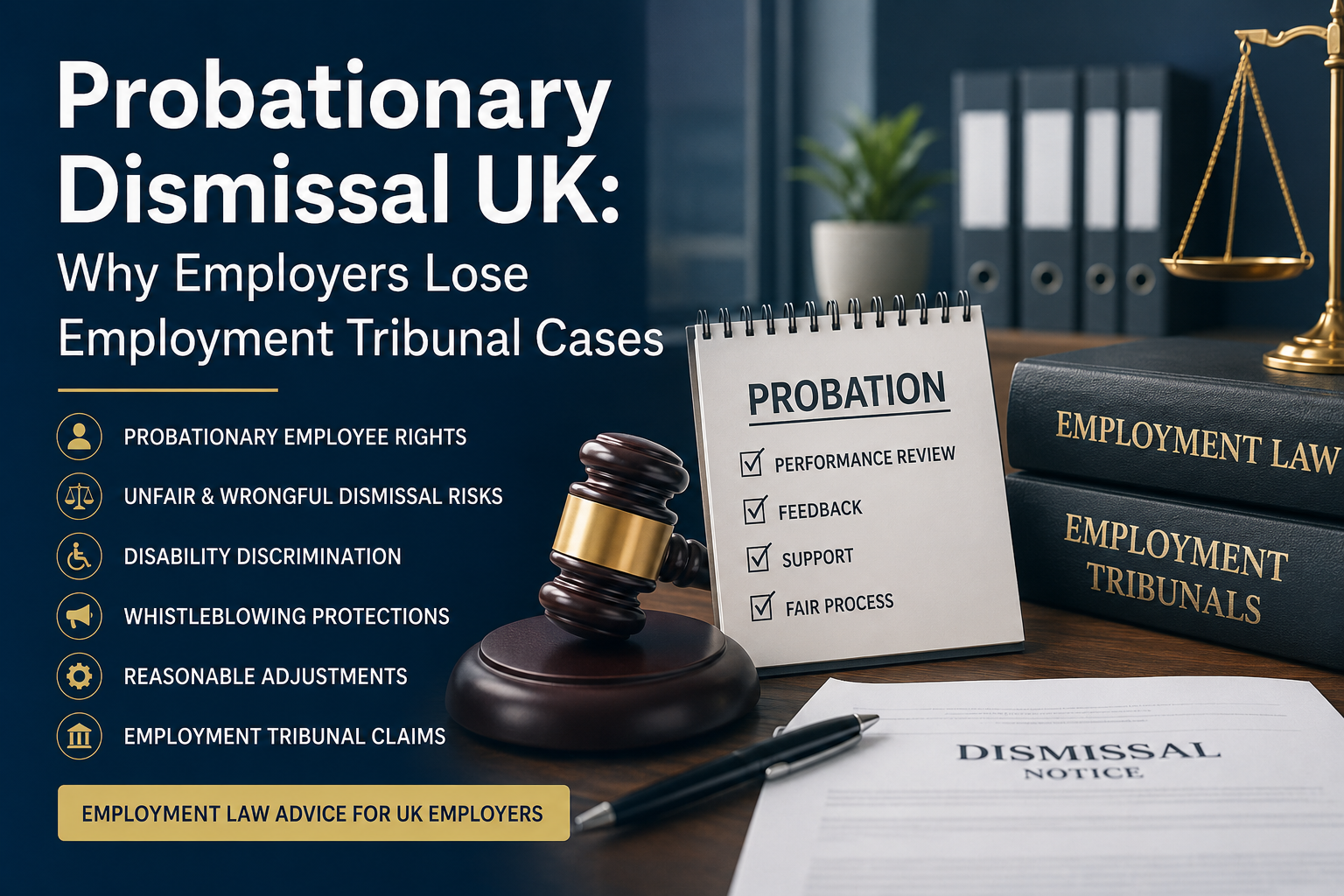
Why UK Employers Lose Tribunal Cases Over Probationary Dismissals
By Yassin Qanbar | Dogetlawyer.com Ai
The Mistake: Why Employers Misunderstand Probationary Dismissals
An employer decides a new hire is not working out. They are still in their probation period, so the employer assumes they can dismiss quickly and move on. No formal meeting. No documented warnings. No written reason. The logic: they have been here less than two years, so they cannot claim unfair dismissal.
That logic is correct on one narrow point, and dangerously wrong on everything else.
Where Employers Lose Employment Tribunal Cases During Probation
The two-year qualifying period only blocks ordinary unfair dismissal. It does not touch discrimination, whistleblowing, pregnancy, or breach of contract. These are day-one rights. There is no probation exception for any of them.
That means every document the employer creates or fails to create during the probation period is potential Tribunal evidence. The termination email. The absence of performance notes. The manager’s Slack message the week after a disability disclosure. If the case reaches a hearing, a Judge will read them all.
The Manufactured Paper Trail: Royal Mail v Jhuti and Whistleblowing Risks
The manufactured paper trail. In Royal Mail Group Ltd v Jhuti, a new employee raised concerns about regulatory breaches during her six-month probation. Her manager responded by building a file of performance criticisms that had not existed before. An independent decision-maker (who was never told about the whistleblowing) dismissed her on that basis.
The Supreme Court looked past the paper trail, found the real reason was the disclosure, and held the dismissal automatically unfair. The lesson: if a Tribunal suspects performance concerns were invented after the fact, the employer’s own documents will be used against them.
The Missing Paper Trail: Disability Discrimination During Probation
In Wright-Turner v London Borough of Hammersmith & Fulham, a senior council employee disclosed ADHD and PTSD during probation. Her manager retrospectively extended the probation period and later dismissed her, backdating the termination letter to predate a grievance she had filed.
There were no contemporaneous records of performance concerns before the disability disclosure. The Tribunal found disability discrimination and awarded approximately £4.5 million. A backdated letter, examined in the evidence bundle, was not clever administration. It was proof of concealment.
No Adjustments, No Conversation: Reasonable Adjustments and Tribunal Risk
In Stanley v The Village Bakery, a legally blind employee told his employer about his visual impairment on day one. Over six weeks, no risk assessment was carried out, no adjustments were made, and no one discussed his difficulties with him. He was dismissed for failing to meet performance standards.
The Tribunal found discrimination: the employer’s own records showed they knew about the disability but did nothing. Silence in the file was not neutral – it was evidence of failure to accommodate.
The Contract the Employer Did Not Read: Wrongful Dismissal and PILON Clauses
In Betancourt v UKRI, an employer terminated one month into probation and paid five weeks’ salary in lieu of notice. But the contract required five weeks’ notice and contained no PILON clause. The EAT held this was wrongful dismissal. The employer’s own contract, produced in evidence, defeated their defence.
What Should Be Done Instead: Reducing Employment Tribunal Risk
Treat every probationary dismissal as if the file will be disclosed to a Tribunal panel. Because it might be.
-
Document performance concerns in writing, as they arise. An email sent at the time is evidence. A retrospective note created after a claim is filed is a liability.
-
Hold a meeting before dismissing. The ACAS Code of Practice is not strictly required for under-two-year employees, but its absence can add 25% to a compensation award and will invite the Tribunal to ask what the employer was avoiding.
-
If the employee has a disability or is pregnant, stop. Consider reasonable adjustments. Take advice. A dismissal that follows a disclosure of disability or pregnancy will be scrutinised for causation, and the burden of proof shifts to the employer.
-
Read the contract before acting. Check the notice clause. Check whether a PILON clause exists. If you breach your own terms, you hand the employee a wrongful dismissal claim on the documents alone.
Recent Legal Developments and Practical Considerations (2026)
The core principles discussed in this article remain unchanged. Employers should remember that probation is a contractual label rather than a legal exemption. While ordinary unfair dismissal claims generally require a qualifying period of service, a range of day-one statutory protections continue to apply, including discrimination, whistleblowing, pregnancy and maternity protections, and certain automatically unfair dismissal claims.
Recent case law continues to demonstrate the risks of treating probationary dismissals as low-risk decisions. In particular, the Employment Appeal Tribunal's decision in Betancourt v United Kingdom Research and Innovation (2025) highlighted the importance of carefully reviewing contractual notice provisions before terminating employment. The case confirmed that payment in lieu of notice may not be effective where the employment contract does not contain an express Payment in Lieu of Notice (PILON) clause.
Employers should also note that ACAS continues to recommend fair procedures when dismissing employees, including communicating the reasons for dismissal, confirming notice arrangements, and providing an opportunity to appeal where appropriate. Although the legal consequences will depend on the nature of the claim and the circumstances of the case, a failure to follow a fair process may significantly increase litigation risk.
The practical lesson remains straightforward: probation does not remove legal risk. It primarily narrows the route for ordinary unfair dismissal claims while leaving contractual obligations, discrimination risks, whistleblowing protections, pregnancy and maternity rights, and other statutory protections fully intact. Employers who maintain accurate records, follow reasonable procedures, consider reasonable adjustments where required, and comply with their contractual obligations remain significantly better placed to defend any subsequent Employment Tribunal claim.
This article reflects the legal position as understood at the date of publication. Employment law develops through legislation and case law, and specific legal advice should be obtained for individual circumstances.
The Takeaway
Probation is not a legal exemption. It is a contractual label. Discrimination awards are uncapped. The Wright-Turner case reached £4.5 million.
The employers who lose these cases share the same trait: they treated probation as permission to skip the basics: documentation, process, and compliance with their own contracts.
A Tribunal will examine what the employer did, what they wrote down, and what they chose not to write down. If those records do not support the decision, the employee wins.
Disclaimer: This article is provided for general information purposes only and does not constitute legal advice. Employment disputes are highly fact-sensitive, and professional advice should be obtained before taking action in any specific case.
References (OSCOLA)
Legislation
- Employment Rights Act 1996.
- Equality Act 2010.
- Trade Union and Labour Relations (Consolidation) Act 1992.
Cases
- Royal Mail Group Ltd v Jhuti [2019] UKSC 55.
- Betancourt v United Kingdom Research and Innovation [2025] EAT 148.
- Really Easy Car Credit Ltd v Thompson [2018] UKEAT 0197/16.
- Wright-Turner v London Borough of Hammersmith and Fulham (ET, 2024).
- Stanley v The Village Bakery (Wrexham) Ltd (ET, 2024).
Official Guidance and Regulatory Materials
- Advisory, Conciliation and Arbitration Service (ACAS), Code of Practice on Disciplinary and Grievance Procedures (2015).
- ACAS, Dismissals https://www.acas.org.uk/dismissals accessed 8 June 2026.
- ACAS, Notice Periods: Notice When Being Dismissed or Made Redundant https://www.acas.org.uk/notice-periods/notice-when-being-dismissed-or-made-redundant accessed 8 June 2026.
- Ministry of Justice, Employment Tribunal Rules of Procedure 2024.
- Equality and Human Rights Commission, Employment Statutory Code of Practice (2011).
- HM Courts & Tribunals Service, Employment Tribunal and Employment Appeal Tribunal Decisions https://www.gov.uk/employment-tribunal-decisions accessed 8 June 2026.
Secondary Sources
- ACAS, Managing Probationary Periods.
- Equality and Human Rights Commission, Employment: Statutory Code of Practice.
- UK Government, Employment Status and Employment Rights Guidance.
